Introduction — Start here
- Go deeper — Browse the Library & Resources.
- Find people — Explore the Community Registry for initiatives near you.
- Take action — Use the Action Kit for practical steps and templates.
- Add knowledge — Read the Contribution Guide to share work with the garden.
This page offers a starting map: principles, followed by patterns, tradeoffs, and ways to plug in. Explore the map, follow what resonates, and contribute what you can. The movement depends on all of us. Together we rise.
On this page: What is Ethereum Localism? · Principles · Applications · Challenges · Mission · Join
What is Ethereum Localism?
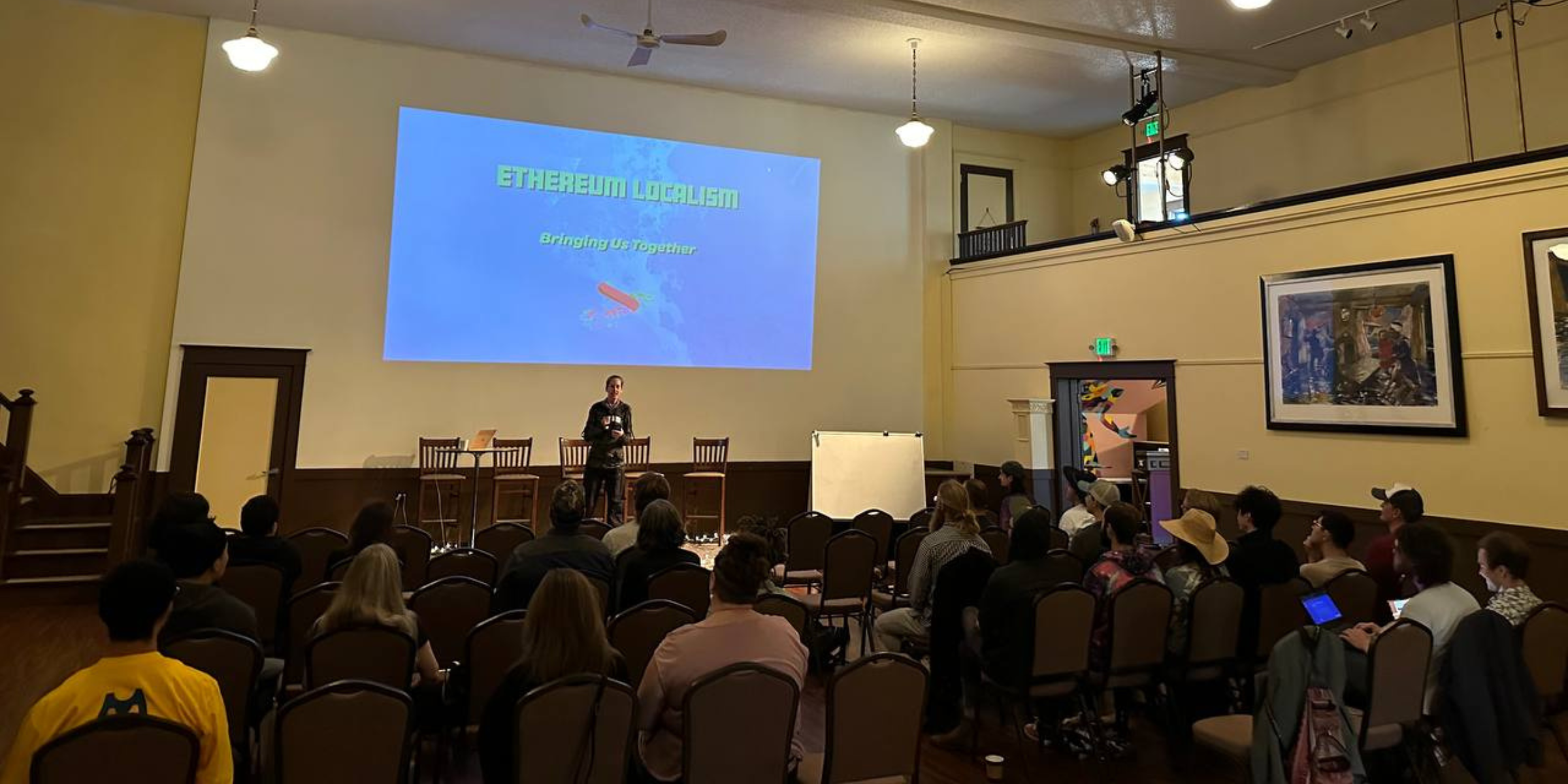
Ethereum Localism is a movement at the intersection of blockchain infrastructure and local empowerment. It asks how Ethereum’s decentralized networks can strengthen place-based economies, governance, and mutual support, without assuming one global template will fit every community or overlooking the opportunities localist applications offer.
Unlike projects that treat “borderless” as the only goal, Ethereum Localism insists on context: the internet and shared protocols connect us globally, but daily life, care, and accountability still live in specific neighborhoods, watersheds, and towns. It works at this intersection, pairing global infrastructure with local responsibility.
Ethereum Localism balances blockchain's global power and intelligence with values-aligned, on-the-ground communities that bring life to the technology — enabling an ecosystem that roots down deeper to rise up higher.
As systems scale, the risk of capture grows unless sovereignty is held close to the ground. We know from history that the kind of technological simplicity that precedes real adoption often shows up first as local experimentation. If that holds, every site of novel local use is a potential inoculation against capture. See localism as an anticapture technology.
CosmoGPT — chat and learn about Ethereum Localism with Cosmo
CosmoGPT is an open, evolving AI steward for the cosmo-localist paradigm, trained on transcripts from General Forum on Ethereum Localism (GFEL) gatherings—commons governance, regenerative economics, decentralized tech, and place-based organizing.
Principles of Ethereum Localism
Foundational Reminders
Before frameworks or tooling, these three anchors help keep work accountable to people and place.
1. Grounded in place. If it's not rooted, it's not localism. Efforts engage the material realities of a specific context — community, food, labor, governance, ecology — whether rural or urban. Our work begins by listening: to the land, to the people already there, and to the conditions that shape daily life. What emerges should feel like it belongs, not like it was imposed.
2. Open by default. Open source and interoperable. Favor coordination and tools that can be forked, remixed, and shared. If others can’t adapt what you build, it isn’t serving the cosmo-local. Openness allows local insights to travel. What is learned in one place can be meaningfully reinterpreted and implemented in another, without losing integrity.
3. Empirical improvisation. If it doesn't work here, it doesn't work. Practice beats abstraction: adapt with feedback, measure viability in use, not in pitch decks. Treat each effort as a living experiment. Stay responsive to what actually happens on the ground, and let reality rather than theory be the guide.
—
Core Principles
These build on the reminders and guide how Ethereum shows up locally.
Decentralization With Purpose
Decentralization is a means toward just, resilient, participatory systems, not an end that excuses recentralization or harm. It should increase agency and freedom where it is needed most and remain accountable to the people it affects. If power quietly recenters, the work is not complete.
Community Sovereignty
Communities should be able to design, govern, and evolve their own digital and economic systems, with open, forkable tools built with the people who use them. This means moving beyond passive adoption toward active stewardship, where communities are not users of systems but co-authors of them.
Regenerative Economic Systems
Prefer models that restore value and stewardship (e.g. ReFi, cooperatives) over pure extraction. Economic flows should nourish the systems they move through, supporting long-term health rather than short-term gain.
Cosmo-Local Coordination
Design global, manufacture local. Share knowledge and protocols globally; implement with local autonomy. This allows communities to draw from a shared commons while adapting to their own conditions, creating diversity without fragmentation. See Shared Definitions: Cosmo-Localism.
Relational Infrastructure
Tools should strengthen trust, care, and cooperation that already exist on the ground, not replace them. Technology is most effective when it deepens relationships rather than abstracts them, supporting the human fabric that makes coordination possible.
Applications and Use Cases
The field of Ethereum Localism is actively taking shape. It is an evolving design space where communities are experimenting with new ways to coordinate, govern, and share resources. This section highlights examples that are already emerging, while inviting further exploration, adaptation, and contribution.
The use cases below represent early patterns and possibilities rather than fixed models. They are signals of what becomes possible when decentralized tools are brought into real-world contexts with care and intention.
Local Currencies
Community currencies, local token systems, and neighborhood marketplaces built on peer-to-peer networks help keep wealth circulating within communities. They support local businesses, strengthen participation, and give communities more agency over how value flows and is recognized. See Field Reports for real-world examples.
- Community currencies co-created with and used by local businesses and markets
- Mutual credit systems for local exchange
- Community-backed vouchers and prepayment systems
- Neighborhood marketplaces and sharing economies
- Worker and producer cooperative token systems
Community Governance
Coordination tools like DAOs (Decentralized Autonomous Organizations) can support transparent, participatory governance for community projects, shared resources, and local decision-making. When grounded in real relationships, these tools help communities make decisions together, allocate resources, and remain accountable over time. See Local DAO Summer and the Fun DAO guide for examples.
- Neighborhood decision-making platforms
- Transparent community treasury management
- Participatory budgeting and proposal systems
- Community steward or council-based governance models
- On-chain voting, signaling, and staking for local initiatives
Commons Management
Smart contracts can help communities steward shared resources by coordinating access, tracking contributions, and supporting fair use over time. From community gardens and tool libraries to shared renewable energy systems and community spaces, they offer a way to manage the commons with transparency, accountability, and care. Explore Implementation Guides like the Regen Hub Playbook.
- Community-managed local infrastructure systems (e.g. energy, water, connectivity)
- Local renewable energy and decentralized data infrastructure systems
- Shared community spaces and equipment libraries
- Community garden coordination and resource sharing
Local Production
Blockchain-based systems can support local production by coordinating distributed manufacturing, tracking provenance of goods, and enabling the sharing of designs and knowledge. They help connect global design commons with local fabrication, making it easier to produce what is needed closer to where it is used.
- Distributed manufacturing coordination
- Open source design repositories with local fabrication
- Supply chain transparency and product provenance
Further reading: Ethereum Localism x Regen Coordination — Powering Regenerative Local Economies with Web3
Challenges and Considerations
Ethereum Localism is an emerging field, shaped in practice across technical, legal, and social terrain. Conditions vary from place to place, and the work asks for care, coordination, and persistence. The challenges listed below are not barriers to avoid, but conditions to work with. They are part of building systems that are grounded, resilient, and responsive to the communities they serve.
| Area | What to watch |
|---|---|
| Technical | Onboarding, user experience, and ongoing maintenance can be difficult for non-specialists. |
| Regulatory | Rules for tokens, treasuries, and community issuance vary by region and continue to evolve. |
| Social / cultural | Building trust, shared understanding, and long-term participation takes time and cannot be automated. |
| Digital divide | Access to infrastructure and digital literacy remains uneven within and across communities. |
| Infrastructure | Networks and tools must function in low-connectivity or resource-constrained environments. |
| Local ↔ global | Balancing interoperability with local autonomy remains an ongoing design challenge. |
| Market volatility | Price fluctuations impact budgets, payroll, and trust in onchain systems. |
Our Mission
Ethereum Localists work to bring decentralized tools into meaningful relationship with place. The aim is not just to build new systems, but to support communities in shaping their own futures with tools that are open, adaptable, and aligned with local needs.
Through this site, we are building a living record of locally rooted initiatives exploring how shared blockchain infrastructure can support resilience, regeneration, and participatory governance. The work is grounded in practice and continues to take shape through real communities.

Join the Movement!
Connect, build, and explore with others working toward more resilient, equitable, local systems. Share what you’re seeing. Build where you are. What takes root locally shapes what grows globally.
More: Tag index · Knowledge Garden home · Ethereum Localism book