From the Intro to the General Forum on Ethereum Localism
Portland, Oregon — October 2023
Speaker: Paul Wackerow (@wackerow)
Thank you, Macks. Thanks, everyone. How’s everyone doing? Welcome to Portland. Can you hear me okay? Great, great.
My name is Paul Wackerow. I’ve been asked to give the talk about why Ethereum. In the context of all this, we just heard a little bit about why Portland, why we’re here, and why this city is such an amazing opportunity to further develop what we’re talking about.
So I’ve been asked to talk a little bit about why Ethereum. I work with the Ethereum Foundation. I’ve been involved with it for the past three years or so, and I’ve only been in Portland for about three and a half. So I think I honestly have more understanding of the Ethereum side than I do the Portland side, so that was very cool.
Let’s get into it.
I want to start by going back a little bit and talking about some of the things about blockchains that we really need to keep in mind as being critically important. There’s a lot of hype around blockchains out there, and a lot of things that don’t necessarily matter — I’m sure many of you are aware.
I also want to talk a little bit about what’s called the scalability trilemma, Ethereum in particular, what Ethereum is doing to address it, and chat a bit about Ethereum governance — how Ethereum actually makes decisions, how things progress and updates go through — and touch on the idea of infinite gardens and infinite games.
So, briefly: RIPCORD. This is an acronym coined by Andreas Antonopoulos. Clap if you’ve heard of Andreas, if you know Andreas. All right. Excellent educator in the space.
He came up with this acronym as a way to describe what aspects of a blockchain we should look at if we actually want to care about it.
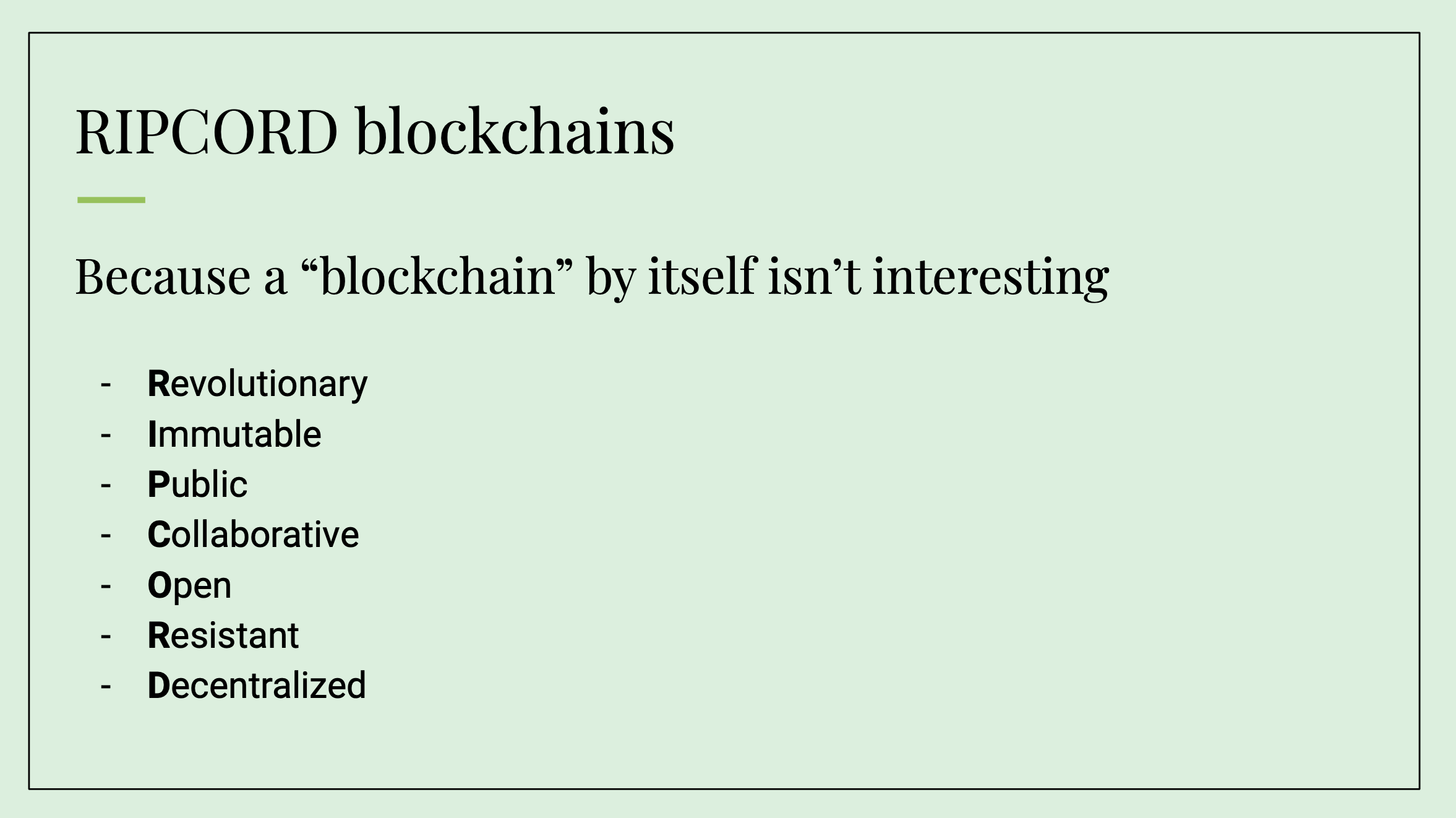
Is the blockchain revolutionary? Is it immutable — meaning it can’t just be changed by anyone? Is it public and open to everyone? Is it a collaborative project, or is it handled by a very select few? Is it open to all? Is it resistant to forms of attacks or from censorship? And is it decentralized?
These are questions you should be considering anytime you look at a so-called blockchain, because by itself, “blockchain” isn’t really all that interesting. It’s these other aspects that come with it that are arguably the most important point.
One of the questions I ask when I’m looking at a network like Ethereum or Bitcoin or any of the other alternative networks out there is: can anyone run a node? Can I run a node? What does it even mean to run a node?
 Raise your hand if you run a node — any crypto node. Awesome. We’ve got a lot of hands. This is great.
So, many of you are familiar. Running a node is just running software that speaks this protocol language to other people, like ourselves, who are running the same software, forming this peer-to-peer network. This is one of the really important questions when you’re assessing what type of blockchain we should be looking at.
Why do we care about blockchains to begin with? We need collaboration tools. We need records of account. We need dependable ledgers that we can share. But we don’t trust each other. I may want one number to be different than the number you want. We’re disparate actors potentially, …but we still want to work together and grow a world. Bitcoin can really help with this stuff. So then, like I said, there’s the question of which network do we want to look at?
And this is where that participation question becomes important. Can you actually participate in the network itself, or not? That’s question number one for me.
In Ethereum’s case, fortunately, the answer is yes. Those of you who have set up nodes may have realized it’s not always super polished or easy, but it is accessible to pretty much anyone who’s willing to take the time to learn and has a couple hundred bucks for hardware.
That cost point matters, because that’s very different from needing thousands, tens of thousands, or even hundreds of thousands of dollars to run infrastructure for some networks.
Throughout its history, Ethereum has taken a methodical — sometimes slower — approach compared to some other layer-one networks, especially around scaling. Those of you who were around a few years ago may have felt the scalability trilemma firsthand, when gas wars picked up, demand increased, and things got really expensive and started pricing people out.
Ethereum knew this was coming. From early days, it was on a mission to transition to proof of stake, which set the stage to address this in more ways.
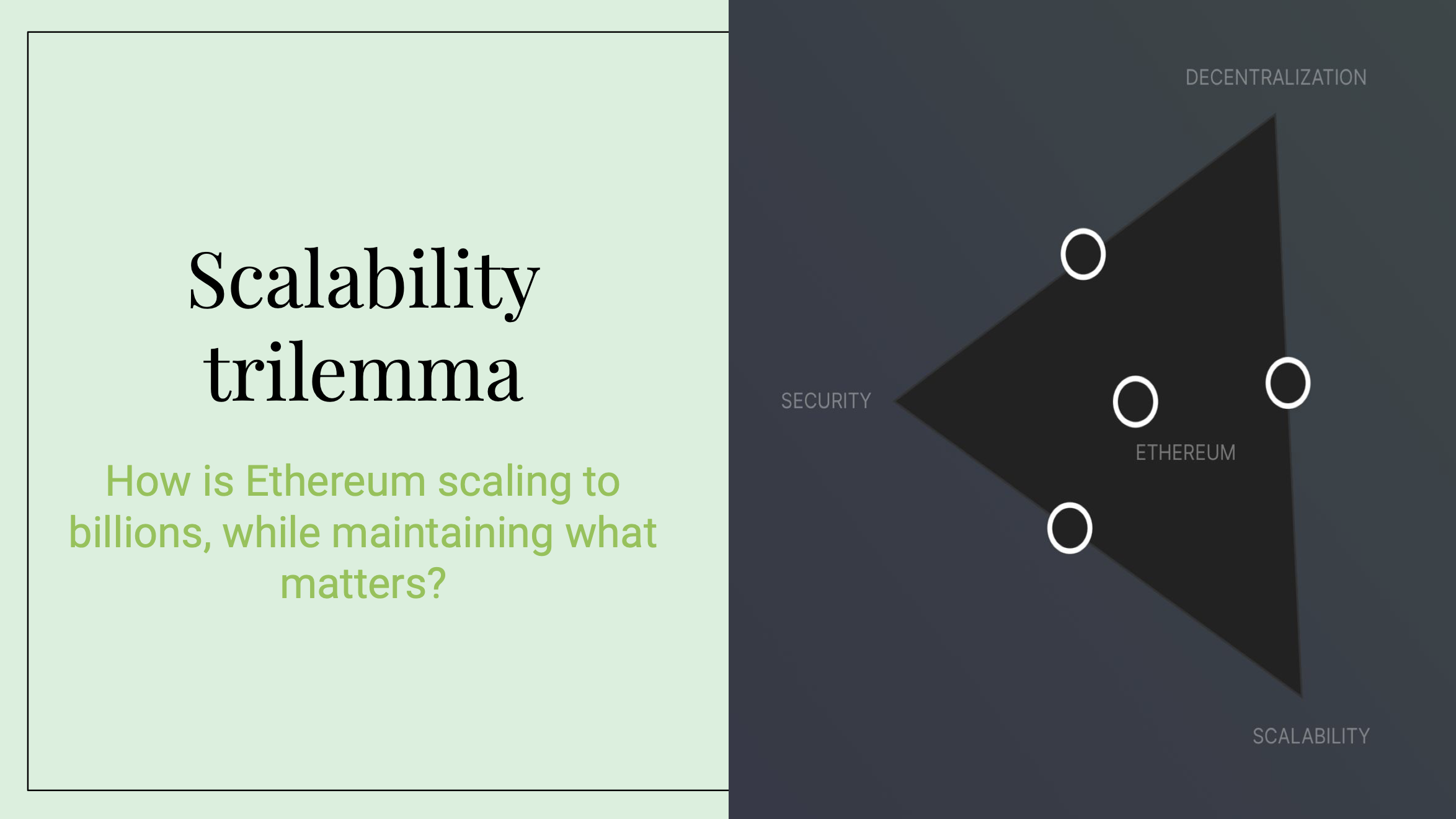
So what is the scalability trilemma? It’s the idea that when you scale networks, you can have two out of three properties — scalability, security, and decentralization — but not all three.
The classic example is Web2: it’s easy to build something highly secure and scalable — Amazon, Google — but they’re centralized and don’t care at all about decentralization.
So how do we expand this to a decentralized network where no single person or entity is in control, but all of us are?
There are shortcuts you can take — like making it much harder to run a node. You can make the technical requirements 10x harder or 10x more expensive, or 100x, why not? A few people will still run it, but most of us will be priced out, and suddenly you don’t really have decentralization anymore. You’re not much better off than Web2.
This is something that’s really pertinent to Ethereum and how it makes decisions. It’s been around for over eight years, with many upgrades, while maintaining the values we cared about from the beginning: censorship resistance, permissionlessness, trustlessness, and sovereign control over your funds.
So how do upgrades actually happen? It’s important to know how the network progresses. The Bitcoin network has undergone very few big changes throughout its history, which is, of course, slightly longer than Ethereum’s.
Ethereum’s approach to governance is socially oriented. There are many classes of actors involved — wallet developers, app developers, community members, core developers, ETH holders, users. It’s a whole slew of people. It’s not a benevolent dictatorship.
For example, the proof-of-stake upgrade that went live about 13 months ago wasn’t decided by one person. It was the result of coordination across all these groups, including the people writing the client software that node operators actually run.
Changes are slow and methodical, and they’re not cast down from on high. People may think Vitalik decides what he wants and then it shall be — but that’s far from the truth, of course. I’m pretty sure that Vitalik has the record for the most number of Ethereum Improvement Proposals that have been rejected.
That should tell you something. Ethereum is much bigger than any one person, and that’s exactly how a network like this should function in order to prosper.
This ties into the idea of trust. Trust is essential for building relationships and a better tomorrow, but humans often struggle with it.
What’s beautiful and powerful about blockchains is that they allow us to offload and delegate certain aspects of trust to machines — to code that’s being executed in a way where its track record so far has been 24-hour uptime every single day. It never goes down and it never gets a single bit off in terms of how it computes something.
So in Ethereum we can trust that. And by delegating that trust, we free ourselves up to do more meaningful things together, to collaborate, to build, and to evolve to further types and levels of trust.
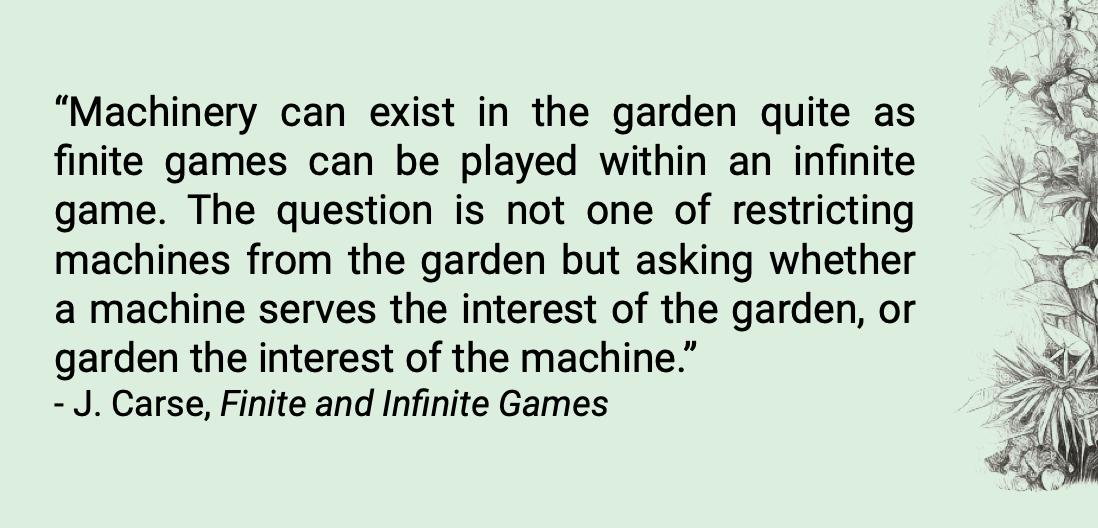
That’s where I want to end, with the idea of infinite gardens and infinite games.
The Ethereum Foundation talks about Ethereum as an infinite garden — an ecosystem we tend together to support infinite games.
Finite games are fun, but they end. You win or lose, and it’s over.
Infinite games keep going.
Life is an infinite game. Happiness is in the play.
Let’s use this technology to build better systems that allow us to keep playing.
And finally, I want to remind people: Ethereum itself isn’t what we care about. I don’t care about Ethereum. I care about my human-to-human interactions. So ideally, Ethereum fades into the background. You won’t have to think about it. Because the more invisible it is, the more we can focus on what really matters — our relationships with each other.
Ethereum holds values that matter: open source, permissionlessness, fairness, sovereignty, and a rejection of centralized kings in favor of shared responsibility and power.
I look forward to seeing how this conference develops. Thank you all for listening.